Sudan: Aid cuts force mass clinic closures, leaving millions without healthcare

Amidst a brutal ongoing war and a catastrophic humanitarian crisis, people in Sudan face reduced access to healthcare as facilities across the country close their doors following broad and historic international aid funding cuts by governments.
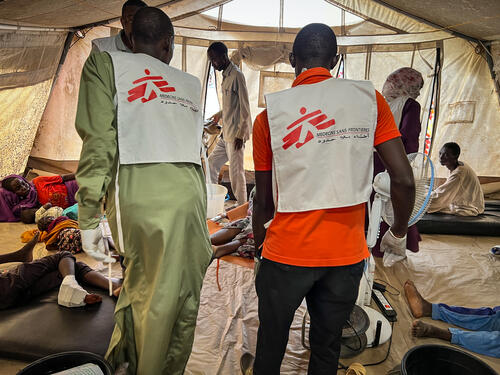
Médecins Sans Frontières / Doctors Without Borders (MSF) warns that this withdrawal of support from an already chronically underfunded crisis is cutting off lifesaving care and pushing the few remaining hospitals to breaking point.
As world leaders gather at the UN General Assembly, governments and institutional donors must protect funding for essential health services in Sudan and provide flexible transitional financing where facilities are at risk of closure.
With aid organisations pulling out, local clinics are left without the funds or medicines needed to function. For patients, this means enduring long, dangerous journeys just to receive treatment.
As they seek help wherever they can, the few hospitals still operational are absorbing the overflow: between January and April 2026, admissions in MSF supported facilities in Zalingei and Rokero in Central Darfur jumped by 22.5 percent compared to the same time last year.
The situation has deteriorated even further as in May alone 45 general healthcare centres in Central Darfur stopped receiving support as the organisation that had been providing resources lacked funding.
Our work saves lives

Three-hour journeys for pregnant women
“War is driving Sudan’s needs; funding cuts are shrinking the response,” says Muhammad Ibrahim, Head of MSF in Sudan.
“MSF’s work in Sudan is privately funded. But when funding disappears from other health services, clinics close, patients have fewer places to go, and pressure shifts to the facilities that remain, including ours.”
“Donors must protect essential health services and provide sustained, flexible funding to organisations that depend on it,” says Ibrahim.
In Tanedba camp, in Gedaref state, home to 18,400 refugees, the sudden departure of a humanitarian organisation in June resulted in the camp’s maternity and surgical wards closing. Pregnant women who need C-sections now face three-hour journeys to the nearest city. MSF has stepped in to run the emergency room there through the end of 2026.
“Closing a clinic does not remove a single patient. It just sends them to the next facility”
In 2021, around 35 aid organisations were working in and around Um Rakuba camp in Gedaref state. Today, fewer than 10 remain. The camp now hosts around 17,000 refugees, mostly women and children.
“Our hospital in Um Rakuba is now the only lifeline left for both refugees and the local Sudanese community,” says Fabrizio Locuratolo, MSF humanitarian affairs manager.
“But the cuts here go well beyond healthcare. Food rations are shrinking and protection programmes are being dismantled, pulling away the last safety nets and leaving refugees completely exposed.”

“MSF cannot absorb every closure”
After the US government announced the closure of USAID in 2025, the grants to many organisations funded to work in Sudan ended in June this year. Although the US government continues to be the largest donor to Sudan, providing funding to the United Nations Office for the Coordination of Humanitarian Affairs (OCHA) and other organisations, many of the existing healthcare providers have been unable to find alternative funding to continue providing services, with health facilities closing in Sudan as a result.
Just as health providers faced the impending removal of US support, many European governments also reduced their assistance to people in Sudan. European and multilateral aid budgets are also shrinking globally. Organisation for Economic Co-operation and Development (OECD) preliminary data show that aid from EU institutions fell by 13.8 percent in 2025, while several major European donors also reduced their overall aid spending. Globally, humanitarian aid fell by 35.8 percent.
These figures do not represent equivalent cuts to Sudan, where some European donors have maintained or increased their support. But they point to a sharply contracting international funding environment. In Sudan, that wider squeeze is compounding an already severe health crisis, as specific funding withdrawals and programme closures reduce access to healthcare.
“Closing a clinic does not remove a single patient. It just sends them to the next facility,” says Sebastián Traficante, MSF emergency coordinator in Darfur.
“After a longer and more expensive journey, patients often arrive in a much more serious condition, and the hospital may already be full. MSF can reinforce some services, but we cannot absorb every closure.”

No food, no health
In Central Darfur’s Hamidiya displacement camp, a health centre that previously provided maternity, paediatric, and mental health care is now operating at sharply reduced capacity after an international aid organisation ended its support. Daily patient visits have dropped from 200 to barely 40, and vaccinations have stopped. The fall was not a sign that people had become healthier.
They had stopped making the journey to a centre that could no longer treat them. A labourer in Darfur earns roughly one US dollar a day. The two dollar transport fare to reach a working clinic therefore costs about two days’ wages, leaving residents to choose between healthcare and food.
“That money could buy food instead,” a patient told MSF. “If there is no food, there can be no health.”
Despite the presence of around 50 NGOs in Tawila, critical gaps persist for up to 600,000 displaced people. MSF runs the only 200-bed hospital in the area and is the only organisation capable of mounting a large-scale epidemic response.

19.5 million
people facing crisis level hunger

37 percent
Proportion of Sudan’s health facilities estimated to be completely out of service
Malaria and malnutrition cases are already rising despite limited rainfall, ahead of the peak of the rainy season – and we expect numbers to increase as the rain intensifies. In August, our teams admitted 191 severely malnourished children under five to our inpatient feeding centre, and nearly 22 percent also tested positive for malaria.
These closures are happening during a large-scale, severely underfunded humanitarian crisis. The UN reports that 825,000 children under five are expected to suffer severe acute malnutrition and 19.5 million people faced crisis-level hunger earlier this year, meaning families either do not have enough food to eat or can only meet basic food needs by resorting to measures such as selling the assets they depend on to survive. Yet the UN’s £2.12 billion response plan is barely 41 percent funded, and 37 percent of Sudan’s health facilities are estimated to be completely out of service.
Liz Harding, MSF UK humanitarian representative, said:
"The UK has said it is ‘protecting’ its humanitarian funding for Sudan. That is welcome, but what needs protecting most is the population in Sudan. With frontline services closing, referral hospitals under growing strain and severe malnutrition rising, static funding will not match the scale of need. If support does not increase, more patients will face longer journeys, fewer treatment options and greater risk of arriving too late for care."
MSF and the crisis in Sudan
The catastrophe in Sudan is not just a humanitarian crisis: it is a global political failure.
The humanitarian response is underfunded, deprioritised, and held back by a lack of political will – both within Sudan and internationally. Diplomatic pressure must be applied to those financing, arming or supporting the warring parties in Sudan, while international humanitarian law must be upheld.
In the meantime, MSF will continue to deliver medical aid where it is needed most.