In photos: Inside MSF's Ebola Treatment Centres

Ebola Treatment Centres, or ETCs, are a vital part of MSF’s Ebola response to contain and treat the disease. Ebola is so deadly that patients need to be treated in isolation by staff wearing special protective clothing. Over the past few weeks since the current outbreak was declared, MSF teams have set up specialised facilities. Here are three of them.

Bunia
On 30 May, MSF teams opened the ETC in Bunia at the epicentre of the current outbreak in the Democratic Republic of Congo (DRC). The ETC provides isolation and care for patients with suspected and confirmed Ebola disease.

Temporary tents within the ETC compound store medical equipment while teams work to scale up the response. The structure is part of the expanding facilities to support patient care and infection prevention and control measures.
Medical care where it's needed most
Right now, our expert medical teams are responding in the Democratic Republic of Congo.
Donate to help MSF act fast and save lives in crises around the world.

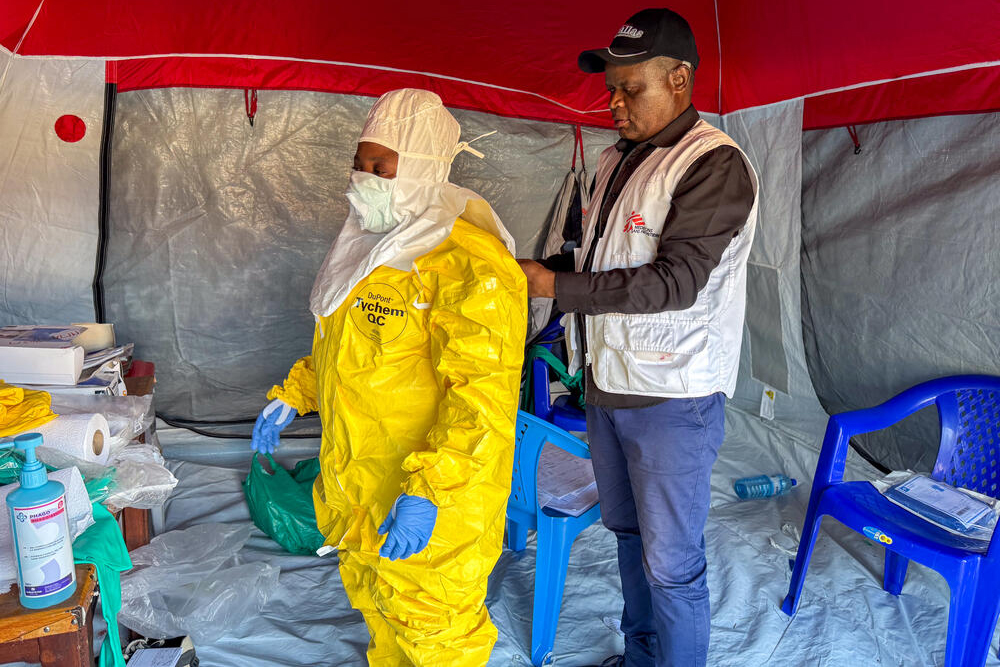
Teams have been training doctors and nurses on strict procedures to avoid infection including assisting them when putting on full personal protective equipment (PPE) in a designated area of the ETC. The suits can look intimidating, but this process helps keep everyone safe when dealing with this infectious disease.

An MSF nurse in full PPE coordinates the arrival of a patient with suspected Ebola disease, guiding the patient through the designated circuit for safe admission.

Immediately after receiving a patient with suspected Ebola disease, a nurse is helped by colleagues for decontamination. This involves more than just taking off the hazmat suit; the boots, the gloves, and the goggles all need treating with disinfectant spray.

MSF staff in PPE decontaminate the vehicles used to transport patients with suspected Ebola disease, ready for the next patient to arrive.

Goma
The first patients were admitted MSF’s ETC in Goma on 28 May. MSF teams are preparing the centre to make sure it’s working at maximum efficiency to support its capacity of 80 patients.


MSF teams follow a strict preparation and disinfection protocol before and after their visits to patients including disinfecting boots and gloves.

Teams are helped into their protective clothing and equipment. The majority of MSF staff are locally recruited healthcare workers who are serving the communities they are from.

Mongbwalu
MSF teams are running a 52-bed ETC within the General Referral Hospital of Mongbwalu in Ituri province. Visual instructions show staff how to correctly put on PPE.

A laboratory technician demonstrates how to use a newly installed Ebola testing machine while conducting some of the first tests at Mongbwalu. The new equipment enables samples to be analysed locally rather than being transported to Bunia.

MSF teams manage the safe handling and preparation of deceased patients before they are transferred to the morgue. Safe and dignified burials – which are crucial for preventing further transmission of Ebola disease – are then carried out by other organisations, in accordance with family's wishes and ensuring cultural and religious traditions are respected.
MSF and Ebola
In the Democratic Republic of Congo (DRC), MSF teams are mobilising to help contain the sudden surge in Ebola cases.
We are leading experts in treating and containing Ebola. MSF was on the frontline throughout the massive 2014-16 West Africa epidemic, and has responded to multiple outbreaks in the DRC alone.