Ebola emergency appeal
Right now, our expert medical teams are responding in the DRC.
Donate to help MSF teams on the ground save lives during the current outbreak.

In the Democratic Republic of Congo (DRC), MSF teams are on the ground treating patients and working to contain the rapid spread of this Ebola disease outbreak.
We are leading experts in treating and containing Ebola. Médecins Sans Frontières / Doctors Without Borders (MSF) was on the frontline throughout the massive 2014-16 West Africa epidemic, and has responded to multiple outbreaks in the DRC alone.
The DRC is facing the worst Ebola disease outbreak in its history with the fastest-spread ever recorded. So far, there are over 6,000 confirmed cases and over 3,000 deaths reported in the DRC. The outbreak's epicentre is in the DRC's eastern province of Ituri, but is spreading to new areas. As cases are now being confirmed in new parts of the DRC, people urgently need a response that matches the scale and speed of the crisis they are facing.
Unlike most previous Ebola disease outbreaks, this one is caused by the Bundibugyo virus. It kills up to 40 percent of those infected, making it less lethal than the more common Ebola virus. However, there is no approved vaccine and no approved treatment, so responding to this virus is particularly challenging.
The World Health Organization (WHO) has declared the situation a "public health emergency of international concern".
Latest Ebola news and stories


How can I help MSF?
Right now, MSF medical teams are responding in the DRC and the region. Donate now to help ensure our expert staff can continue to save lives.
We urgently need your support to help us treat and contain Ebola.


£77
could pay for a set of personal protective equipment for staff in an Ebola treatment centre

The latest: How is MSF responding to the Ebola disease outbreak?
Right now, we have over 1,700 members of staff responding to the outbreak in eastern DRC. Our medical and logistics teams are working around the clock in collaboration with the Congolese health authorities.
- On 9 May, MSF received alerts of deaths from a 'suspected viral haemorrhagic fever' spreading since the start of April. We sent a team to investigate with the Ministry of Health.
- In Mongbwalu – currently considered the epicentre of the outbreak in Ituri – MSF has built a 65-bed Ebola Treatment Centre (ETC) for suspected and confirmed cases. Meanwhile, teams are supporting the hospital there by creating temporary isolation capacity, triaging, and reinforcing infection prevention and control (IPC) measures. MSF is also supporting safe and dignified burials.

- Our teams rehabilitated and opened an 80-bed Ebola treatment centre in Goma city. We also established an isolation ward in Kyeshero Hospital and supported the training of staff.
- A first team of emergency responders arrived on 20 May and immediately started reinforcing IPC measures in more than 20 health facilities.
- Additional medical staff have been recruited locally to reinforce the response, including doctors, nurses and hygienists working jointly with MSF and the Ministry of Health.
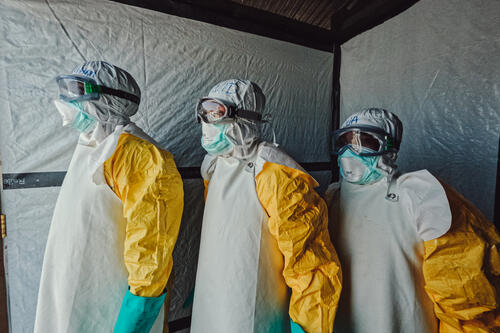
- Several hundred tons of medical and logistics supplies have been delivered to affected areas from MSF’s international logistics hubs. This includes essential personal protective equipment (PPE) such as gloves, masks, goggles, gowns and protective boots. Several tonnes of supplies continue to arrive in the DRC each week.
- In South Kivu, MSF teams have set up ETCs in Bukavu and Lwiro. At the same time, they are training health workers on IPC measures in both cities.
- Alongside medical activities, MSF medical, logistical and health promotion teams continue to engage with the community and conduct awareness raising activities.
MSF teams are often among the first humanitarian responders on the ground for one key reason: because we are already there. MSF has been working in the DRC since 1977, providing vital healthcare services through conflict, disaster and disease.

What is Ebola?
Ebola is a rare but deadly disease which can kill up to 90 percent of those infected.
The most commonly known viruses within the Ebola disease genus are the Ebola virus, Sudan virus and Bundibugyo virus. There is an approved treatment and a preventive vaccine for the Ebola virus. But the current Ebola outbreak reported in the DRC is caused by the Bundibugyo Ebola virus, for which there is no approved vaccine or treatment.
It can be difficult to diagnose because the early symptoms, like a fever and sore throat, are common. To confirm an Ebola diagnosis, special tests need to be carried out. These require test kits specific not to the disease itself, but to each individual virus in order to detect it. However, these test kits are currently in short supply for the Bundibugyo virus, which significantly slows down case confirmation and, consequently, the implementation of contact tracing and patient isolation.
Ebola can be transmitted from both animals and humans. Human-to-human transmission happens through close contact with blood, secretions, or other bodily fluids of infected individuals. This is why people have to wear full personal protective equipment to prevent catching or spreading the virus.
Medical teams can give patients the best chance of survival by helping to manage the symptoms of the virus, and treating other diseases the patient may have.
Once a patient recovers from Ebola, they’re immune to the form of the virus they contracted.

Our experience: Responding to Ebola in the West Africa outbreak
Between late 2013 and 2016, an outbreak of Ebola in West Africa became a major international emergency. The severity of the epidemic saw MSF launch one of the largest emergency operations in its history.
MSF responded in the three most affected countries - Guinea, Sierra Leone and Liberia – and also to the spread of cases to Nigeria, Senegal and Mali.
At the peak of the epidemic, MSF employed nearly 4,000 local medical staff and more than 325 international staff who ran Ebola treatment centres, as well as conducted surveillance, contact tracing, health promotion and provided psychological support.
MSF admitted 10,310 patients to its Ebola management centres, of which 5,201 were confirmed Ebola cases, representing one-third of all WHO-confirmed cases.
MSF and Ebola
Ebola is one of the world’s deadliest diseases.
The virus can kill up to 90 percent of the people who catch it, causing terror among infected communities.
In recent years, MSF teams have fought major outbreaks of Ebola in DRC and West Africa.
Stay up to date with MSF's Ebola response and our vital emergency work around the world
Sign up to Frontline, our monthly email newsletter. You'll receive carefully curated stories from our staff worldwide, underreported issues and unheard voices, as well as event invitations and unique opportunities to get involved.
We'll also send you urgent updates and disaster appeals when it matters most. If an emergency happens, you'll be the first to hear from our expert teams on the ground.