Sudan: MSF launches an emergency response in North Kordofan

MSF teams have started water and sanitation activities in the main displacement camp of El Obeid, the capital of North Kordofan state, and we are ready to expand healthcare activities in the city and other areas of the Kordofans region.
As violence continues to spread across Sudan, the Kordofan states in the south-central part of the country have remained one of the most volatile and active conflict zones. The area is also one of the least accessible regions for humanitarian organisations.
At the heart of this vast area, the city of El Obeid is a major refuge for displaced families fleeing violence. Living conditions here are precarious: access to healthcare is limited, safe drinking water is scarce, and sanitation facilities are insufficient to meet rapidly growing needs.
In response, Médecins Sans Frontières / Doctors Without Borders (MSF) launched emergency activities in El Obeid in late January. The first phase is to improve the water and sanitation services in the city’s main displacement site.
“El Obeid lost many of its original residents but today it hosts tens of thousands of displaced people who settled here in different moments of the war,” says Al Tayeb Mahmoud Mahammed, MSF’s team leader in El Obeid.
“With the frontline less than 25 miles away, the city continues to receive new arrivals almost daily. People arriving here are deeply scared as the fighting draws closer. Yet they still feel safer than where they came from, where they were exposed to violence, looting, and beatings.”
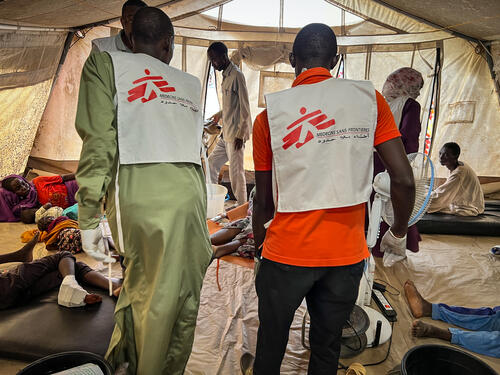
Our work saves lives
Al-Mina Al-Muwahad, the main displacement site of El Obeid, hosts approximately 25,000 people as of the end of January 2026, according to MSF’s assessment. At the site, we saw an alarming lack of services for the amount of people living there.
There are severely inadequate sanitation services, with 500 people sharing one latrine at times. As well, there is limited access to safe drinking water, with only three litres per person per day. This significantly increases the risk of disease outbreaks, placing particularly children, pregnant women, and the elderly at heightened risk.

MSF teams are constructing additional latrines and installing water bladders to strengthen water and sanitation services in the camp. They are also supporting community-based disease and nutrition surveillance through Ministry of Health community health volunteers.
As people’s needs far exceed the capacity of an already fragile health system, MSF is coordinating with the local authorities to support the provision of healthcare activities in the camp as well as at El Obeid Teaching hospital.
MSF’s current response in El Obeid follows months of engagement with local and federal authorities to gain access to the city. In July 2025, we launched a remote response to support with trainings and technical advice the Ministry of Health during a cholera outbreak and in September last year we found major humanitarian needs among the community, as well as cases of measles and cholera, during an assessment carried out on site.

“As fighting continues and displacement rises, humanitarian needs across Sudan remain immense and largely unmet,” says Marta Cazorla, MSF head of operations in eastern Sudan.
“We are grateful to be finally present and operating in El Obeid, something that was not possible for the larger part of the conflict due to access constraints.”
“This response is a critical step, but far more assistance is urgently needed to prevent further loss of life and degradation of dignity,” says Cazorla.
“MSF teams are currently ready, and supplies are prepared, to expand the response in El Obeid, as well as to assess and respond in other areas across the Kordofans as needs evolve and access allows. Right now, for example, we have teams ready to provide medical care in South Kordofan.”
MSF and the crisis in Sudan
According to the International Organization for Migration, since the conflict in Sudan began on 15 April 2023, more than 15 million people have been forced from their homes, including 11.5 million displaced within Sudan and approximately 4 million who fled across borders at the peak of the crisis.
MSF runs or supports 20 hospitals and 16 healthcare centres in Sudan. Our medical teams provide surgical care, wound management, physiotherapy, maternity, nutrition and paediatric services, general healthcare, routine and reactive vaccination campaigns, and mental health support in eight of country’s 18 states.