South Sudan: “I ran for my safety once I heard the shooting”

Following the recent escalation of violence in Jonglei state, South Sudan, Médecins Sans Frontières / Doctors Without Borders (MSF) staff have been forced to flee their homes. One nurse shares his testimony of being separated from his family after his home was burned down and belongings looted.
In total, 26 of 291 MSF colleagues working in Lankien and Pieri remain unaccounted for following the recent attacks on MSF facilities. MSF is making every possible effort to re-establish contact with our missing colleagues and to support all affected staff and their families.
For Albert*, an MSF nurse in Lankien, the destruction of MSF’s hospital on the night of 3 February 2026 was not only the loss of his workplace. It was the loss of his home and the sudden separation from his family.
“They bombed exactly at 9pm. I was not in the compound that day; we were ordered to move away from the compound. The following morning, I ran for my safety once I heard the shooting.”
Large parts of the MSF hospital in Lankien were damaged during the bombardment and later burned down, including warehouses, fuel stores, and critical support structures. Medicines, vaccines and blood supplies were destroyed or looted. As the violence intensified in the days that followed, health workers fled alongside Lankien residents.
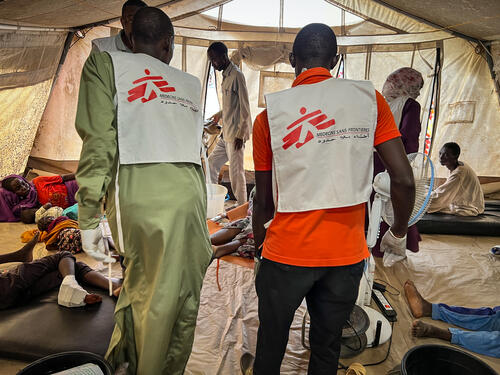
Many MSF staff were forced to flee the violence, and several are now displaced, sheltering in remote areas with little access to food, water or basic services. Beyond MSF being forced to suspend medical activities for approximately 250,000 people across the two locations, this crisis has directly affected the very health workers who were providing care to their communities.
“I am separated totally from my family, my wife and my children," Albert says, "I do not know where they are. I do not know if they are still alive or not.”
Our work saves lives
Health workers at risk
On the Tuesday of the airstrike, Albert had already followed instructions to evacuate amid rising tensions and warnings of a possible attack on the town. As the bombardment intensified, his house was burned and his belongings looted. He fled into the forest carrying only a small bag containing fortified peanut paste, biscuits, and his documents.
He walked for five days through remote areas, avoiding armed men, before reaching safety. “I ate the peanut paste and biscuits on the way. It was the only survival meal I had.”
Albert is now temporarily staying with a friend in Juba.
“I find myself doing okay physically, although emotionally I am totally distressed, because I do not know where my kids are.”
“This violence has taken an unbearable toll not only on healthcare services but on the very people who kept them running. Medical workers must never be targets”
Albert’s experience reflects that of many health workers who were forced to flee, lost their homes, and remain uncertain about the safety of their loved ones. Beyond the destruction of medical infrastructure, the violence has deeply affected the very people who were providing care.
Despite his own trauma, Albert continues to think about his patients.
“My top priority is to pray hard for that vulnerable population. Wounded children will be sent away from Lankien [without receiving care] because of the crisis.”
“There is always a way out. In every situation, there is a way out.”
Albert is among many MSF colleagues who have been confirmed to have reached safety. However, out of 291 locally recruited staff working in Lankien and Pieri, MSF has lost contact with 27 others and remains extremely concerned about their wellbeing.
“This violence has taken an unbearable toll not only on healthcare services but on the very people who kept them running. Medical workers must never be targets,” says Yashovardhan, Head of MSF in South Sudan.
Conflict in South Sudan
Since the beginning of 2025, MSF has documented a sharp increase in attacks on healthcare facilities in South Sudan. By February 2026, MSF had recorded 10 targeted attacks on our hospitals or staff. Such attacks violate international humanitarian law, endanger medical workers, and deprive communities of essential and life-saving care.
MSF has worked in the area now known as South Sudan since 1983, and continues to provide medical assistance across multiple states and administrative areas of the country.
MSF in South Sudan
In July 2011, South Sudan became the world’s newest country after gaining independence from Sudan. The peace deal that led to the split also ended Africa’s longest running civil war. But in December 2013, South Sudan civil war erupted again, forcing millions of people from their homes, leaving many without access to basic necessities, such as food, water and healthcare.
Although a peace deal was reached in 2018, the security situation remains volatile in many areas, with factional violence continuing to hit communities hard.
Médecins Sans Frontières/Doctors Without Borders (MSF) works in hospitals and clinics throughout South Sudan, where we run some of our biggest programmes worldwide.