South Sudan: Critically ill patients' lives at risk due to access restrictions

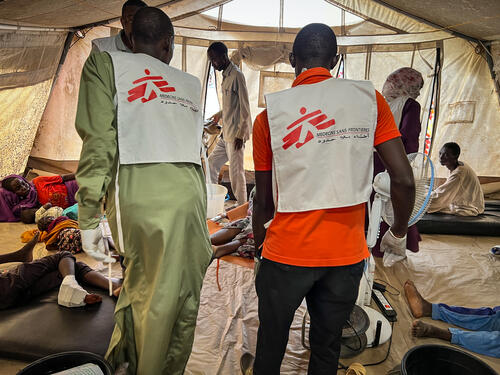
Restrictions on MSF movements in parts of Jonglei state, South Sudan, are directly placing patients’ lives at immediate risk. At least 20 critically ill patients in need of urgent specialised care are unable to receive life-saving referrals. Every delay in referral increases the likelihood of death or permanent disability for patients who cannot be treated locally.
Since 30 December 2025, essential healthcare services to conflict-affected communities have been significantly constrained by access restrictions. These restrictions made it impossible for necessary medical supplies to reach the MSF hospital in the town of Lankien and the primary healthcare centre in Pieri.
What’s happening in South Sudan?
In 2025, violence between government and opposition forces, and non-state armed groups steeply increased in South Sudan, marking the worst escalation since the signing of the 2018 peace agreement. Last year, MSF recorded at least eight attacks on health facilities and workers across the country, leading to the closure of two hospitals and the suspension of primary healthcare in Jonglei, Upper Nile, and Central Equatoria states.
The ongoing conflict is affecting every aspect of peoples' lives. The interruption of health services is particularly increasing risks for vulnerable groups, including children, pregnant women, and people living with chronic or life-threatening conditions.
“Lives are being put at risk every day because critically ill patients cannot be referred for the care they urgently need,” said Gul Badshah, MSF Operations Manager.
“Patient referrals are not optional or administrative procedures; they are lifesaving interventions. MSF is requesting unhindered humanitarian access, including predictable and regular flights to Jonglei state, to allow timely referrals for all critically ill patients, the delivery of essential medical supplies and staff rotations.”
As of mid-January 2026, humanitarian organisations working in South Sudan have been unable to secure sustained and predictable access to parts of the Jonglei State. Without humanitarian aid, peoples' health conditions are getting worse.
“Health facilities supported by MSF are already facing critical service disruptions: in Lankien and Pieri, MSF is now able to offer only life-saving and emergency care,” added Badshah.
“Before the access constraints, MSF was receiving 1000 patients in Lankien, and 700 in Pieri, on a weekly basis. To better illustrate the current situation, the total catchment area for both facilities is around 250,000 people.”
Our work saves lives
Conflict has also led to people fleeing their homes, with an unknown number of people fleeing to remote areas to avoid airstrikes and fighting.
Many people, particularly women and children, remain displaced and without access to basic healthcare. Continued access constraints are likely to make the challenges of displacement worse, weaken the community's methods of coping, and further strain limited local health capacity.
MSF was forced to evacuate some of the staff members from Lankien Hospital on 31 December. The hospital currently offers only lifesaving and emergency care.
MSF in South Sudan
MSF has been present in what is today South Sudan since 1983 and remains one of the largest medical humanitarian actors in the country, currently operating in six states and two administrative areas. In 2025, MSF provided more than 830,000 outpatient consultations, inpatient care for over 93,000 patients, including 12,000 surgeries, screened 107,000 children for malnutrition, and performed regular critical referrals across the country. Sustained and predictable humanitarian access is essential to maintain lifesaving services and to prevent further deterioration of health outcomes for communities in Jonglei State.