DRC: Meet the MSF staff behind the masks of the Ebola crisis

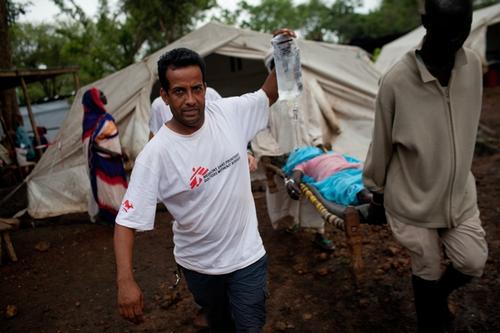
Médecins Sans Frontières / Doctors Without Borders (MSF) teams are responding to the most severe Ebola outbreak in the Democratic Republic of Congo's history. As they work tirelessly to contain the disease, some have shared personal accounts of the toll it is taking on their families, colleagues and community.
Since May 2026 when it was declared, the Ebola outbreak in the DRC has infected more than 11,000 people and caused over 5,000 deaths. Even tiny levels of exposure to the Bundibugyo virus can cause infection – and the mortality rate is close to 50 percent.
MSF staff are not immune to the disease. Although there are strict infection prevention measures at Ebola treatment centres, most responders come from communities affected by the outbreak, where there is an everyday risk of transmission.
Sadly, 29 of the nearly 2,900 MSF Ebola responders have been infected this year, and three have died.
Each MSF team member has their story. We hear how they are facing the toll of the disease and their motivation to keep on going.
Help us prepare for the next emergency
What's happening in the DRC?
Since May 2026, MSF teams have been on the ground in the DRC treating patients and working to contain the raid spread of the Ebola disease outbreak.
MSF was on the frontline throughout the massive 2014-16 West Africa epidemic, and has responded to multiple outbreaks in the DRC alone.
This comes at a time when violence is escalating in the eastern part of the country, causing mass displacement and growing medical and humanitarian needs.

“When I see my patients, I see myself” – Dr Sylvain Radjabu Lubangi, doctor
Having survived the disease himself, Dr Sylvain knows how frightening it can be.
“When I learned that I was positive, I was in shock,” he says. “At the beginning of the outbreak, many people were dying. I thought I was going to die too.”
Dr Sylvian contracted the virus before joining the MSF-run treatment centre in Bunia, Ituri province, which has since been closed. Admitted to this facility, he learned that other health workers had died in the region. “That was very hard,” he says. “I was afraid. I kept thinking maybe I would be next.”
But he found the strength to fight.
“I told myself Ebola is a disease like others - you can receive care and recover,” he says. “I had to stay strong mentally.”
After recovering, Dr Lubangi chose to return to the frontline.
“Now, when I see patients, I see myself,” he says. “I know the fear, the pain and the uncertainty. That gives me even more empathy, and more strength to help them.”
“When someone walks out alive, it is a great joy” – Vivuya Kavira Mwenga, nurse
The wards are nearly full at the MSF Ebola treatment centre in Beni, North Kivu, where Vivuya works as a nurse.
When patients arrive, her team isolates them, monitors them closely and treats their symptoms. There is not yet a specific approved treatment for the Bundibugyo virus responsible for the current outbreak.
“We cannot cure Ebola caused by the Bundibugyo virus yet, but we can treat the symptoms,” she says. “Coming early, before complications develop, gives patients a better chance.”
What keeps her going is seeing patients recover.
“When someone walks out alive, it is a great joy,” she says. “That is what we want for every patient.”
"Returning to work has been a source of pride."


“People listen to me. I know what it is like to suffer from Ebola” – Dieudonné Tchuma Longa, health promoter
Dieudonné raises awareness about the dangers of Ebola in Mongbwalu and advises people how to stay safe.
“We go door to door, organise community meetings and speak with religious and other community leaders,” Dieudonné says. "We explain that Ebola is real and that people should seek care as soon as symptoms appear.”
Dieudonné lost eight members of his family to Ebola in one month, including his father and only son. Then, he caught the virus itself. He believes he was infected at his father’s funeral.
“It was difficult to cope. But now, people listen to me because I have seen with my own eyes what happens with Ebola. I experienced it. It is important to build a connection with the community because people need to understand the outbreak."
"For me, returning to work has been a source of pride."

“Every night, my heart was bleeding for our patients” – Alice Alyerunga, nurse
Alice, a nursing supervisor, has worked for MSF for 12 years, but has never wrestled with an emergency on this scale.
“It is the most stressful event I have been a part of. At the beginning, it was catastrophic. We had no survivors for three weeks. Around 100 people died. Every night, my heart was bleeding for our patients,” Alice says. “When we had our first survivor, it was a joyous moment.”
“As frontline health workers, we face high levels of exposure, even with PPE. This means that it can be frightening to work here, but we are motivated by our mission to save lives and break the chains of transmission.”

“Sometimes they are dead by the time they arrive” – Richard Kasereka, ambulance driver
Richard is an ambulance driver working in Mongbwalu, Ituri, where the outbreak began.
“In bad cases, there is a lot of blood, diarrhoea and vomiting. It is risky because these fluids are highly infectious," Richard says. "Sometimes the person is nearly dead when we pick them up. Sometimes they are dead by the time they arrive.”
These scenes can be upsetting for staff.
“It is not easy. But this work demands that we adapt,” says Richard.
“We are here to save lives and I prepare myself mentally – and physically – by doing everything possible to protect myself. I respect the protocols, wash my hands a lot, and use sanitation gel.”
"To save lives, we need to earn the trust of the population” – Samson Balidja, assistant country director
Samson was among the first MSF staff to arrive in Mongbwalu, Ituri province, where the outbreak is thought to have begun. But distrust of the healthcare response remains.
“We were threatened, and a group of youths set fire to a tent we had set up next to the hospital to receive patients,” Samson recalls.
“They didn’t believe Ebola was serious. They thought non-governmental organisations (NGOs) had created it to make money.”
More recently, Samson and his colleagues were attacked while assessing health needs in another part of the province where Ebola cases had been detected.
“They threatened us, saying we would not make it out alive,” he says.
Despite this, Samson remains resolute.
“To save lives, we need to earn the trust of the population,” he says. “We need to reinforce community engagement, help communities understand why we are there, and work alongside them.”
"If we keep going: I’m optimistic that we can defeat this epidemic.”


“If we don’t isolate and treat patients, a single case can wipe out a whole village” – Judith Mudjagani, nurse
Before joining MSF, Judith worked in a local maternity clinic in Bunia, Ituri province without adequate protective equipment.
“For months before the outbreak was declared, we were treating sick patients without proper protection,” Judith says. “In early June, I tested positive for Ebola. I’m sure it was because I had been working without protection.”
Judith recovered, but the experience left her deeply shaken. “It was frightening. I know other health workers who have died," she says.
But she is driven by a strong sense of duty.
“If we don’t isolate and treat patients, a single case can wipe out an entire village,” she says. “But if we keep going: I’m optimistic that we can defeat this epidemic.”
MSF and the Ebola crisis
The DRC is facing the worst Ebola disease outbreak in its history with the fastest-spread ever recorded. More than 10,000 Ebola cases have now been recorded in the DRC, with over 4,800 deaths since the Ebola outbreak was declared on 15 May 2026.
Médecins Sans Frontières / Doctors Without Borders (MSF) teams are on the ground treating patients and working to contain the rapid spread of this Ebola disease outbreak. MSF was on the frontline throughout the massive 2014-16 West Africa epidemic, and has responded to multiple outbreaks in the DRC alone.
As cases are now being confirmed in new parts of the DRC, people urgently need a response that matches the scale and speed of the crisis they are facing.