Acting fast to save lives during an outbreak

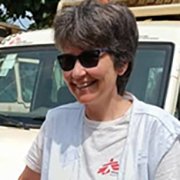
Facing the fastest-spreading Ebola disease outbreak in the country's history, MSF's outreach team in the Democratic Republic of Congo (DRC) needs to move quickly.
When a crisis hits somewhere new, MSF teams may conduct an ‘explo’ to see if people there need our help. That means diving into the unknown, as Dimitrinka Tomova explains...
“When I arrived in the DRC, a lot was unclear. But one thing that was clear was that we needed to slow the spread of the disease. And that meant improving the detection, isolation and referral of people with symptoms of Ebola. That was paramount.
MSF has vast experience in responding to Ebola disease outbreaks, and has been present in Ituri – the province where the outbreak started – for years.
However, we also had to move quickly to new areas where we didn't already have resources in place. This included Mongbwalu, the town at the outbreak’s epicentre.
While I was there, cases were reported in new areas. We needed to conduct ‘explos’: exploratory expeditions to find out how we could help. Whenever this happens in MSF, these are the steps we take:
1 | Finding information
First, we start to hear from people in the community and the Ministry of Health that the spread of Ebola is beginning to affect more people from a certain area. Then we discover there's no humanitarian organisation present there. Those factors might suggest that something is going on and needs attention, because usually what we hear is just the tip of the iceberg.
Then we try to build more of a picture, with the crucial contribution of the epidemiologist who analyses the dynamics of the epidemic, and feed all this information back to MSF’s coordination team. The team then look at the information, look at the map, look at our capacity and decides, ‘okay, it looks like we need to go to that area, that area, and that area.’
"We need to gather as much information as possible in a limited time to inform life-saving decisions"
2 | Planning
From the moment the coordination team approves the project, we set to work planning.
One of the most important things is to reach out to the local people, including any health centre, to make them aware of what we’re trying to do. We don’t want to just show up somewhere unexpectedly and say, “hello, we are MSF”: speaking with local communities, listening to their concerns, and building trust is essential.
Around 90 percent of MSF’s staff in the DRC are recruited locally, and we work closely with local health facilities. When we’re going somewhere new, we try to be accompanied by someone who has already worked with us and is trusted by the community.
For example, the chief nurse at one of our partner health centres knew the chief nurse at the centre we were trying to reach. He came with us and helped introduce us.
Logistically, we need to deploy vehicles with staff, all the materials for sleeping and eating, plus medical and other essential supplies. In the medical team we prepare our emergency bags, as well as data collection tools: we need to gather as much information as possible in a limited time to inform life-saving decisions.
Alongside the medics, there’s the logistics team, the health promotion team, and a project coordinator. Planning and preparing an explo is a huge team effort. I never thought we could be that fast, but it only took us a few days to plan and prepare.

3 | Getting there
The region around Mongbwalu is difficult to access: it’s in the jungle and the roads are unpredictable. It's also controlled by different armed groups and our security team works hard to help us negotiate access when we're trying to reach people in urgent need of healthcare. We don't want to have any difficulties on route when going through checkpoints.
We’re diving into the unknown.
Photos taken by Dimitrinka of the health centre in rural Ituri, including the solar power system and the medical supply storage.
4 | At the destination
Once we arrive at our destination the project coordinator will go and speak to the community leaders.
The medics usually stay in the health centre, while the health promotion team works within the communities. In this way, we gather information about the patients, the Ebola cases, as well as the dynamics in the local area and any difficulties preventing people from accessing care.
We take a lot of photographs because there’s nothing better than visual material for showing the severity of the situation and what might be needed.
In some places, communities have very little; the health centre might have no water or electricity.

5 | Back to base
Finally, we need to go back and put together our report. This can be a stressful, intense time because we have to do it quickly after the explo. The report is complex, and every team has a perspective to contribute.
Once all information has been gathered, we submit our findings and recommendations to the coordination team, which makes the final decision on how to proceed. Teams may be mobilised immediately to launch the new project.
Whilst I was in the DRC, the outreach team was able to go on four explos, and I went on one of them. Now MSF teams are taking on new health centres that are in dire need of support. These are the places where the outbreak needs to be tackled first because sadly, so many Ebola deaths happen in the community, outside of major hospitals and treatment centres. We can train people to recognise symptoms fast, set up proper isolation areas and make sure that infection prevention measures are in place.
But we’re not just making an impact in treating people with Ebola disease, we’re also making sure that the basic healthcare for people continues despite the outbreak. So mothers don't die in labour and children don't die of asthma attacks.
During previous outbreaks I’ve worked on the frontline, providing care to patients in the Ebola treatment centre. I never knew the extent of the outreach programme and I'm glad I had this opportunity to work in it because it's so important to stopping the outbreak and saving lives.
MSF and the Ebola outbreak
The DRC is facing the worst Ebola disease outbreak in its history with the fastest-spread ever recorded. More than 10,000 Ebola cases have now been recorded in the DRC, with over 4,800 deaths. The outbreak's epicentre is in the DRC's eastern province of Ituri, but is spreading to new areas.
Right now, we have over 2,800 members of staff responding to the outbreak in eastern DRC. Our medical and logistics teams are working around the clock in collaboration with the Congolese health authorities.